How it counts
A raw hit count is not a click count
The gap is enormous, and it is not evenly spread — it clusters exactly where marketing works hardest. Three kinds of thing fetch your link before any person does. Here is what they are, how Badger Links tells them apart from a visitor, and what it still cannot catch.
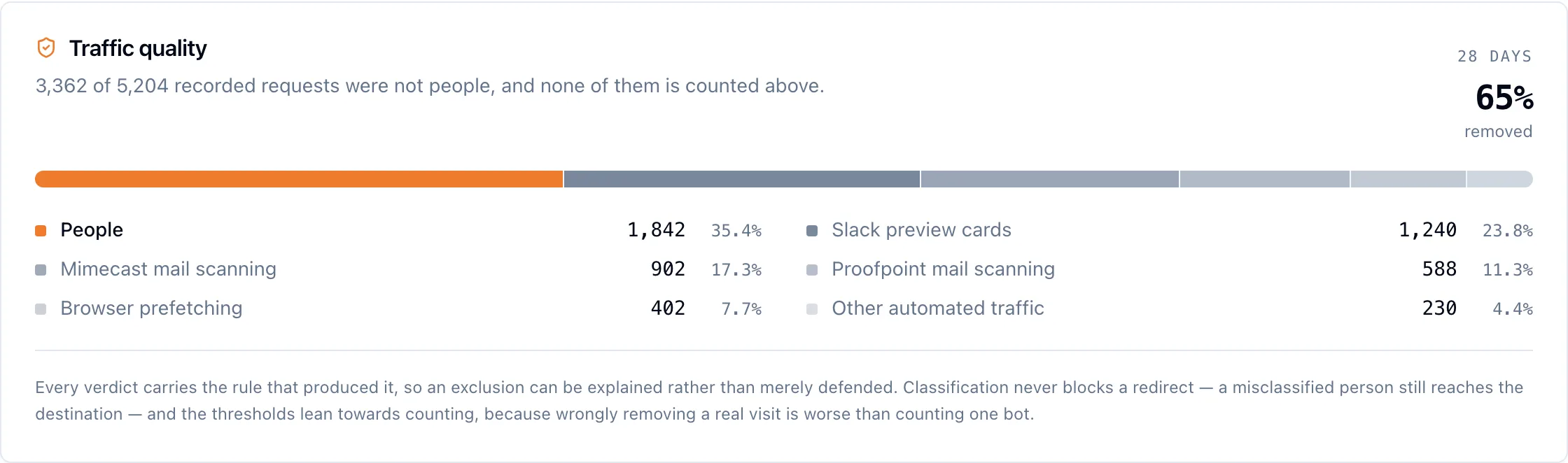
Who is fetching your links
Three things that open a link before anyone clicks it
A tool that reports these as clicks produces numbers that fall apart the moment someone senior asks why the click count exceeds the number of recipients.
Link previews
Slack, LinkedIn, WhatsApp, Discord, Telegram, X. Each fetches the URL to build a card. One post in a busy channel can generate hundreds of requests before a single person sees it.
Mail security
Mimecast, Proofpoint, Barracuda, Symantec, Zscaler. They open the link before the recipient does — often within seconds of the send, which is exactly when you are watching the number.
Browser prefetch
Chrome may load a link from the address bar before anyone has decided to go there. It says so when it does, which makes this the one kind of automated traffic there is no argument about.
The classifier
Six signals, in the order we trust them
Nothing is removed anonymously. Every visit we set aside is reported with the reason, so a report answers the question rather than raising it: not “4,000 clicks were excluded”, but “3,100 were Slack building preview cards, 600 were Mimecast scanning the newsletter, 300 were Chrome loading the page early”.
Visits that announce themselves
Some browsers say outright that they are loading a page ahead of time, in case you go there next. Nobody has decided to visit yet, so nothing is counted.
Requests no browser makes
Link checkers and mail gateways ask whether a link works without ever opening it. Somebody following a link never does this.
Cloudflare’s bot detection
Every request arrives through Cloudflare, which sees automated traffic across a large share of the web and recognises tools a single link never could.
Known previews and scanners
Slack, LinkedIn, WhatsApp, Mimecast, Proofpoint and the rest identify themselves by name. The most specific match wins, so a tool imitating another is not mistaken for it.
How automated the visit looks
For anything that gave nothing away. The judgement leans towards counting: leaving out a person deletes a real click from your report, which is the worse mistake.
Whether it was a real page visit
A click opens a page. Something pulling the same address quietly in the background is doing another job, and says as much when it arrives.
Constraints
Two rules the classifier works under
Both cost us a little accuracy on paper. Both are the right trade.
- Classification never blocks a redirect
- If we get it wrong, the person still arrives where they were going. Working out what a visit was never delays it and never stands in its way.
- Thresholds lean towards counting
- Leaving out a real person deletes a click that happened, which is worse than counting one machine. Where it is genuinely close, the visit is counted.
What it cannot catch
Microsoft Safe Links
Recognising Microsoft Defender’s link scanning, so mailboxes protected by it report as cleanly as the rest. It is the one kind of automated traffic Badger Links still counts as people.
So if your audience is largely on Microsoft 365, expect a share of the scanning to still be counted as people. It is the one gap we know of, and it is on the way out.
See it on your own traffic
The free plan carries the whole report, not a preview of it. Ten links is enough to point one at a campaign you recognise and read what comes back.